 Historic Marker
Marker · Memory
Juvenile Rearing Area
Inscription
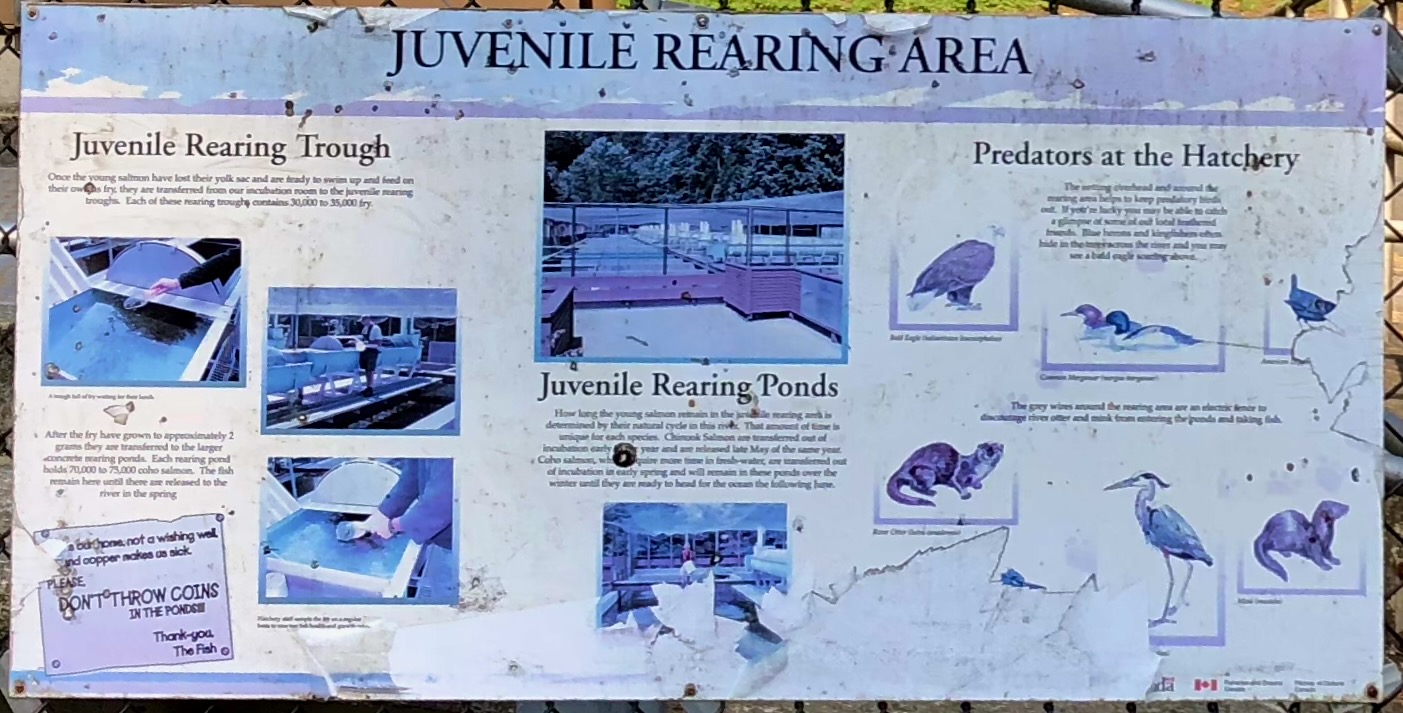
JUVENILE REARING AREA ===== Juvenile Rearing Trough ===== Once the young salmon have lost their yolk sac and are ready to swim up and feed on their own as fry, they are transferred from our incubation room to the juvenile rearing troughs. Each of these rearing troughs contains 30,000 to 35,000 fry. [Photo: A trough full of fry waiting for their lunch] [Photo: Close-up of juvenile salmon] After the fry have grown to approximately 2 grams they are transferred to the larger concrete rearing ponds. Each rearing pond holds 70,000 to 75,000 coho salmon. The fish remain here until they are released to the river in the spring. [Decorative element: Fish silhouette] A fish loves, not a wishing well, and copper makes us sick. PLEASE DON'T THROW COINS IN THE PONDS!!! Thank you, The Fish :) [Small text: Fisheries staff accepts the fish as complete / how to use the fish health board: specific info] ===== Juvenile Rearing Ponds ===== [Photo: View of juvenile rearing ponds with netting] How long the young salmon remain in the juvenile rearing area is determined by their natural cycle in the wild. That amount of time is unique for each species. Chinook Salmon are transferred out of incubation early in the year and are released late May of the same year. Coho salmon, which require more time in fresh-water, are transferred out of incubation in early spring and will remain in these ponds over the winter until they are ready to head for the ocean the following June. ===== Predators at the Hatchery ===== The netting overhead and around the rearing area helps to keep predatory birds out. If you're lucky you may be able to catch a glimpse of some of our local feathered friends. Blue herons and kingfishers often hide in the trees across the river and you may see a bald eagle soaring above. [Illustrations of predatory birds and animals:] - Bald Eagle (Haliaeetus leucocephalus) - Great Blue Heron - Common Merganser (Mergus merganser) - River Otter (Lutra canadensis) - Mink (Mustela) The grey wires around the rearing area are an electric fence to discourage river otter and mink from entering the ponds and taking fish. [Canadian flag] Fisheries and Oceans Pêches et Océans Canada Canada
Awaiting verification
Record
- Marker type
- Sign
- Current condition
- Fair, as of the 2018 survey
- Location
- Capilano River Regional Park — North Vancouver, British Columbia
- Added to the archive
- July 27, 2018
Interpretive sign describing the juvenile salmon rearing process, rearing troughs, rearing ponds, and predators at the Capilano River Hatchery.
Condition over time