 Historic Marker
Marker · Memory
Pioneering Facilities
Inscription
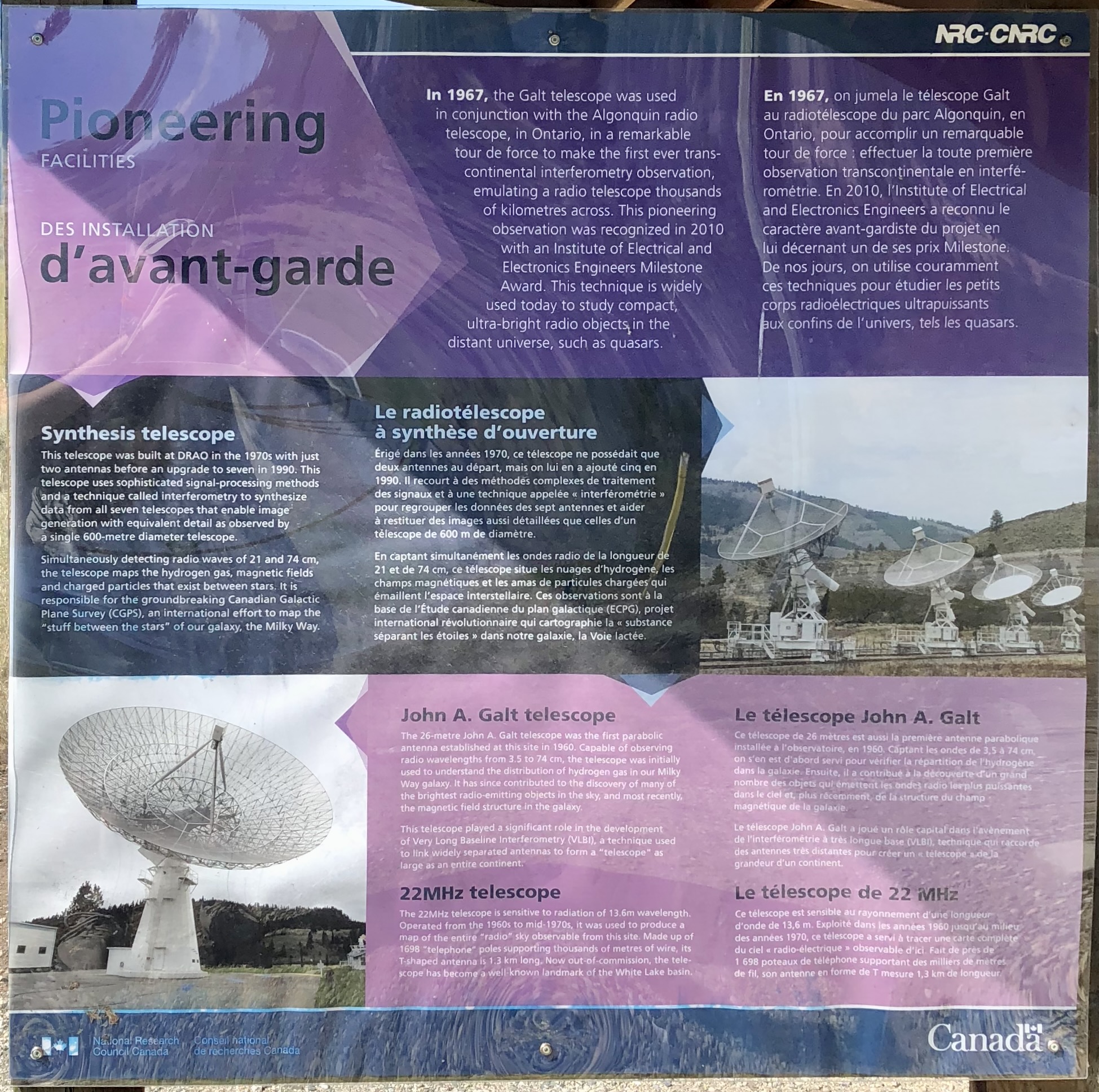
NRC CNRC Pioneering FACILITIES DES INSTALLATION d'avant-garde [Photo: Large radio telescope dish] In 1967, the Galt telescope was used in conjunction with the Algonquin radio telescope, in Ontario, in a remarkable tour de force to make the first ever trans-continental interferometry observation, emulating a radio telescope thousands of kilometres across. This pioneering observation was recognized in 2010 with an Institute of Electrical and Electronics Engineers Milestone Award. This technique is widely used today to study compact, ultra-bright radio objects in the distant universe—such as quasars. En 1967, on jumela le télescope Galt au radiotélescope du parc Algonquin, en Ontario pour accomplir un remarquable tour de force: effectuer la toute première observation transcontinentale en interférométrie. En 2010, l'Institute of Electrical and Electronics Engineers a reconnu le caractère avant-gardiste du projet en lui décernant un des ses Milestones. De nos jours, on utilise couramment ces techniques pour étudier les petits corps radioémissiques ultrabrillants aux confins de l'univers, tels les quasars. Synthesis telescope Le radiotélescope à synthèse d'ouverture This telescope was built at DRAO in the 1980s with just two antennas before an upgrade in the early 1990s. This telescope uses sophisticated signal-processing methods long applied, called interferometry, to produce digital from all seven receivers that enable image construction with resolution 1000x better than the human eye. The telescope maps the hydrogen gas, magnetic fields, and charged particles from the Super Galactic plane. It helped contribute observations to the Canadian Galactic Plane Survey (CGPS), an international effort to map the "stuff between the stars" of our galaxy, the Milky Way. Écrit durant les années 1970, ce télescope ne possédait que deux antennes au départ, mais on l'a amélioré entre 1980 et 1990. Il met à contribution des techniques complexes de traitement des signaux—l'interférométrie—pour fusionner les données provenant des sept récepteurs et les assembler, formant une image ayant une résolution 1 000 fois supérieure à celle de l'oeil humain. Cet instrument contribue à l'Étude canadienne du plan galactique (ECPG), projet international visant à cartographier les « vides » dans notre galaxie, la Voie lactée. John A. Galt telescope Le télescope John A. Galt The 26 metre John A. Galt telescope was the first parabolic radio telescope in Canada. This pioneering telescope was built by NRC and began observations of hydrogen in our galaxy in 1959. The telescope is named for John A. Galt who led its construction and later became the first Director of DRAO. The telescope detects radio emission from the hydrogen gas in our galaxy and measures the brightest radio-emitting elements in the sky and used meteors. Its moveable dish has a diameter of 26 metres. Le télescope de 26 metres est le premier télescope parabolique radioélectrique jamais construit au Canada. Cet appareil pionnier a été érigé par le CNRC et a commencé à observer l'hydrogène dans notre galaxie en 1959. L'observatoire l'a baptisé John A. Galt en l'honneur de l'ingénieur qui a présidé à sa construction et est devenu par la suite le premier directeur de l'OFR. Le télescope détecte l'émission radio de l'hydrogène gazeux dans notre galaxie et mesure les éléments du ciel. 22MHz telescope Le télescope de 22 MHz With an observing wavelength of 13.6m wavelength, Operated from the 1960s to mid-1970s, it was used to produce a map of the radio sky from the Northern Hemisphere. Over 6000 measurements of solar radio brightness were made with its array of dipoles positioned in a T shaped pattern, a 1.2 km east-west and 0.4 km north-south. Once observations for this project were completed, the site was dismantled. Ayant une longueur d'onde de 13,6 m, ce télescope, qui a fonctionné des années 1960 au milieu des années 1970, a servi à produire une carte du ciel radio de l'hémisphère Nord. Le réseau de dipôles était disposé en forme de T sur 1,2 km est-ouest et 0,4 km nord-sud. Une fois la cartographie terminée, le télescope a été démonté. National Research Conseil national Council Canada de recherches Canada Canada
Awaiting verification
Record
- Marker type
- Sign
- Current condition
- Good, as of the 2018 survey
- Location
- Dominion Radio Astrophysical Observatory — White Lake, British Columbia
- Added to the archive
- July 22, 2018
- Tags
- astronomy, science, technology, telescopes
Bilingual interpretive sign describing the pioneering radio telescope facilities at DRAO, including the synthesis telescope, John A. Galt telescope, and 22MHz telescope.
Condition over time