 Historic Marker
Marker · Memory
History of White Lake Basin
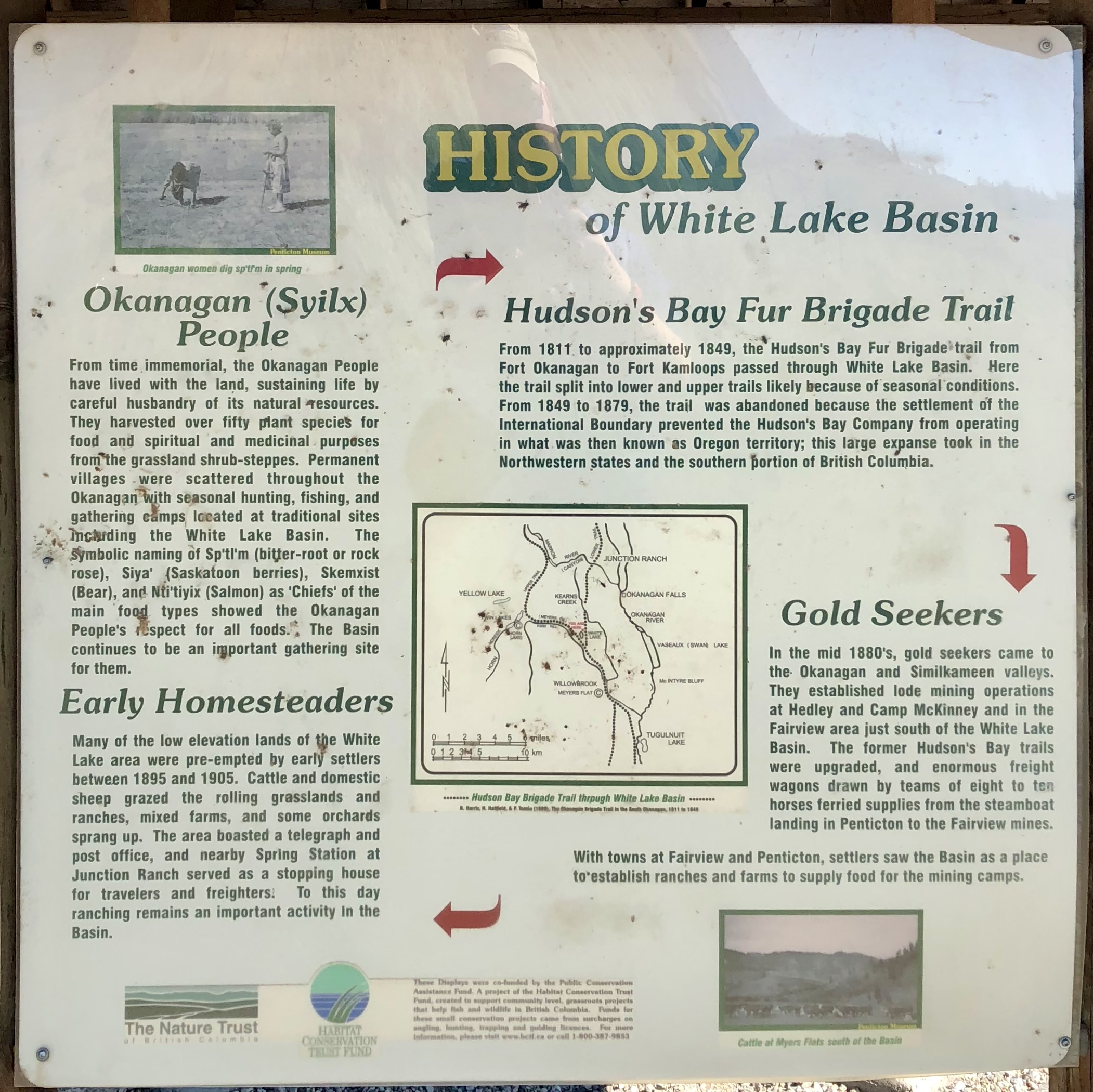
Inscription
HISTORY of White Lake Basin [Photo: Okanagan women dig sp7ím in spring] Okanagan (Syilx) People From time immemorial, the Okanagan People have lived with the land, sustaining life by careful husbandry of its natural resources. They harvested over fifty plant species for food and spiritual and medicinal purposes from the grassland shrub-steppes. Permanent villages were scattered throughout the Okanagan with seasonal hunting, fishing, and gathering camps located at traditional sites including the White Lake Basin. The Syilx naming of Sp7ím (bitter-root or rock rose), Siya (Saskatoon berries), Skmxist (Bear), and Ntityix (Salmon) as 'Chiefs' of the main food types showed the Okanagan People's respect for all foods. The Basin continues to be an important gathering site for them. Early Homesteaders Many of the low elevation lands of the White Lake area were pre-empted by early settlers between 1895 and 1905. Cattle and domestic sheep grazed the rolling grasslands and ranches, mixed farms, and some orchards sprang up. The area boasted a telegraph and post office, and nearby Spring Station at Junction Ranch served as a stopping house for travelers and freighters. To this day ranching remains an important activity in the Basin. Hudson's Bay Fur Brigade Trail From 1811 to approximately 1849, the Hudson's Bay Fur Brigade trail from Fort Okanagan to Fort Kamloops passed through White Lake Basin. Here the trail split into lower and upper trails likely because of seasonal conditions. From 1849 to 1879, the trail was abandoned because the settlement of the International Boundary prevented the Hudson's Bay Company from operating in what was then known as Oregon territory; this large expanse took in the Northwestern states and the southern Portion of British Columbia. [Photo: Hudson Bay Fur Brigade Trail through White Lake Basin] Gold Seekers In the mid 1880's, gold seekers came to the Okanagan and Similkameen valleys. They established lode mining operations at Hedley and Camp McKinney and in the Fairview area just south of the White Lake Basin. The former Hudson's Bay trails were opened, and enormous freight wagon driven by teams of eight to ten horses ferried supplies from the steamboat landing in Penticton to the Fairview mines. With towns at Fairview and Penticton, settlers saw the Basin as a place to establish ranches and farms to supply food for the mining camps. [Photo: Cattle at Meyers Flats south of the Basin] The Nature Trust HABITAT CONSERVATION TRUST FUND
Awaiting verification
Record
- Marker type
- Sign
- Current condition
- Good, as of the 2018 survey
- Location
- Dominion Radio Astrophysical Observatory — White Lake, British Columbia
- Added to the archive
- July 22, 2018
- Tags
- history, indigenous, fur-trade, gold-rush
Interpretive sign covering the human history of the White Lake Basin, including the Okanagan (Syilx) People, early homesteaders, Hudson’s Bay Fur Brigade Trail, and gold seekers.
Condition over time