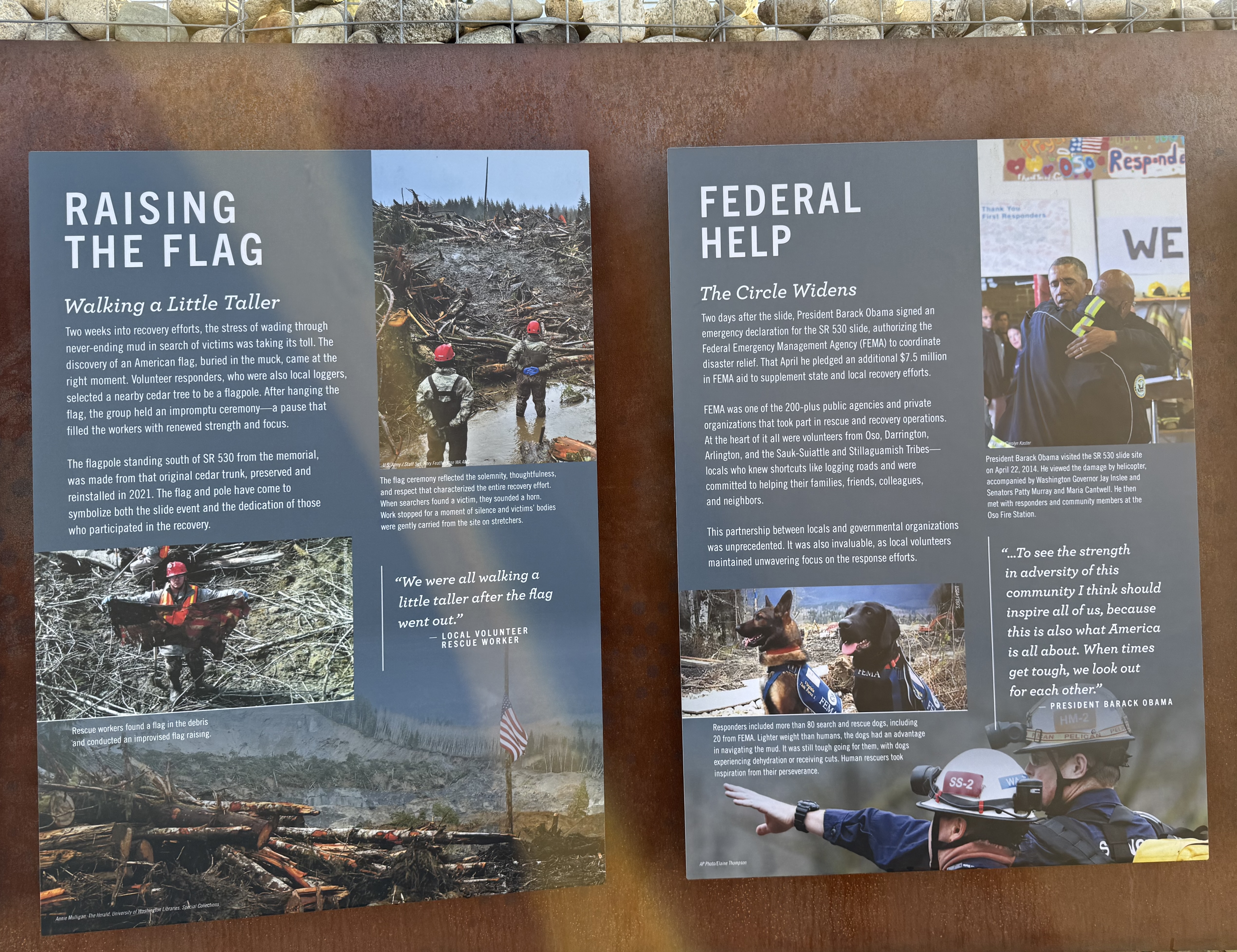
 Historic Marker
Survey · January 25, 2026
Raising the Flag / Federal Help
As documented January 25, 2026.
- Survey date
- January 25, 2026
- Condition
- Good
- Condition notes
- Two-panel display, both panels intact and fully legible; no fading, cracking, or graffiti visible. Sunlight glare falls diagonally across the left panel in this photograph.
Inscription
RAISING THE FLAG Walking a Little Taller Two weeks into recovery efforts, the stress of wading through never-ending mud in search of victims was taking its toll. The discovery of an American flag, buried in the muck, came at the right moment. Volunteer responders, who were also local loggers, selected a nearby cedar tree to be a flagpole. After hanging the flag, the group held an impromptu ceremony—a pause that filled the workers with renewed strength and focus. The flagpole standing south of SR 530 from the memorial, was made from that original cedar trunk, preserved and reinstalled in 2021. The flag and pole have come to symbolize both the slide event and the dedication of those who participated in the recovery. [Photo, upper right: two responders in red helmets and waders standing in a field of downed timber, mud, and standing water] [Credit printed along the lower edge of that photograph:] U.S. Army / Staff Sgt. Rory Featherston WA ANG The flag ceremony reflected the solemnity, thoughtfulness, and respect that characterized the entire recovery effort. When searchers found a victim, they sounded a horn. Work stopped for a moment of silence and victims' bodies were gently carried from the site on stretchers. "We were all walking a little taller after the flag went out." — LOCAL VOLUNTEER RESCUE WORKER [Photo, left: a responder in a red helmet and orange vest lifting a muddy flag from a tangle of broken branches] [Credit printed sideways along the right edge of that photograph:] The National Guard / Air Force MSgt [UNVERIFIABLE: photographer's forename and surname — below resolution against the branch debris] Rescue workers found a flag in the debris and conducted an improvised flag raising. [Photo across the bottom of the panel: an American flag hanging from a point below the top of a tall bare pole at right, above felled logs and root wads in mud, with a bare gray slide scarp and standing timber behind] [Credit printed along the bottom edge of the panel:] Annie Mulligan, The Herald. University of Washington Libraries, Special Collections --- FEDERAL HELP The Circle Widens Two days after the slide, President Barack Obama signed an emergency declaration for the SR 530 slide, authorizing the Federal Emergency Management Agency (FEMA) to coordinate disaster relief. That April he pledged an additional $7.5 million in FEMA aid to supplement state and local recovery efforts. FEMA was one of the 200-plus public agencies and private organizations that took part in rescue and recovery operations. At the heart of it all were volunteers from Oso, Darrington, Arlington, and the Sauk-Suiattle and Stillaguamish Tribes— locals who knew shortcuts like logging roads and were committed to helping their families, friends, colleagues, and neighbors. This partnership between locals and governmental organizations was unprecedented. It was also invaluable, as local volunteers maintained unwavering focus on the response efforts. [Photo, upper right: Obama embracing a man in a high-visibility jacket in a room hung with children's drawings and hand-lettered signs] [Credit printed in that photograph's lower left corner:] [UNVERIFIABLE: glare-washed credit prefix] Carolyn Kaster President Barack Obama visited the SR 530 slide site on April 22, 2014. He viewed the damage by helicopter, accompanied by Washington Governor Jay Inslee and Senators Patty Murray and Maria Cantwell. He then met with responders and community members at the Oso Fire Station. "...To see the strength in adversity of this community I think should inspire all of us, because this is also what America is all about. When times get tough, we look out for each other." — PRESIDENT BARACK OBAMA [Photo: two search dogs in vests seated in front of slide debris and heavy equipment] [Credit printed sideways up the right edge of that photograph:] USDA / USFS Responders included more than 80 search and rescue dogs, including 20 from FEMA. Lighter weight than humans, the dogs had an advantage in navigating the mud. It was still tough going for them, with dogs experiencing dehydration or receiving cuts. Human rescuers took inspiration from their perseverance. [Photo across the bottom of the panel: two responders in helmets and safety glasses, one pointing off to the left] [Credit printed in that photograph's lower left corner:] AP Photo/Elaine Thompson
Awaiting verification